
Gemology · Diamond Simulants · Natural Gemstones
More Than a SparkleThe History of History’s Greatest Diamond Impostors
IntroductionThe 2,000-Year Hustle

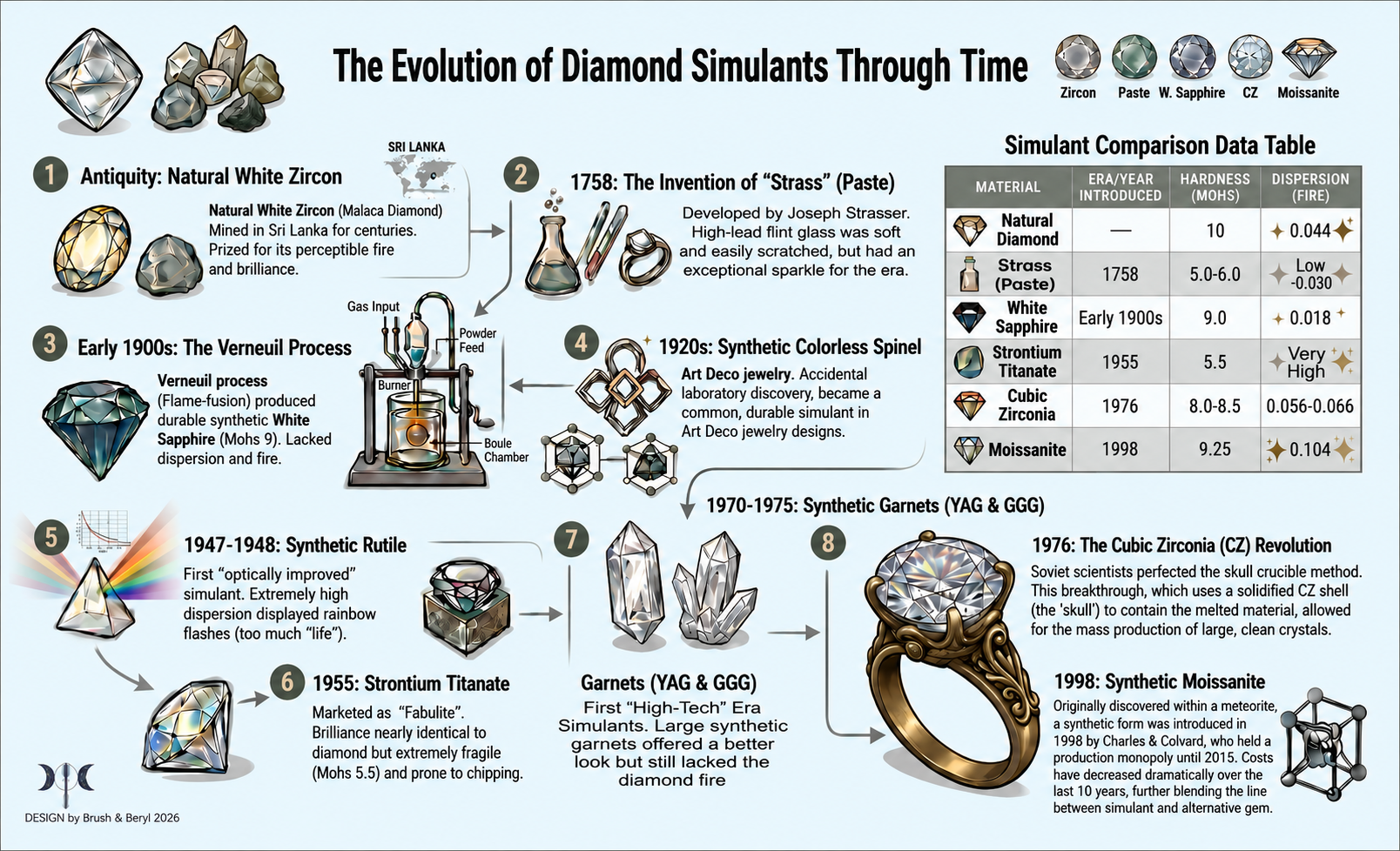
The human obsession with the diamond is not merely a romance with geology; it is a centuries-old saga of a high-stakes subterfuge. Of course nature has always provided its own optical stand-ins, most notably natural zircon. Recognized as the world's oldest known gemstone, colorless zircon served as one of the earliest and most convincing natural diamond simulants thanks to its impressive brilliance and fire. Yet, just as humanity has been relentlessly obsessed with the alchemical dreams of turning copper into gold, merely uncovering a natural substitute was never enough. The true fixation lay in replication. The relentless drive to engineer a man-made simulant completely dominated the search for a diamond alternative.
To navigate this world of deceptive brilliance, one must first master the terminology of the trade. A diamond simulant is an optical interloper; an often human made material that attempts to match diamond's distinct "fire" but shares none of its chemical or physical properties. By contrast, a lab-grown diamond is the stone’s true carbon copy, a high tech replication that possesses an identical lattice of pure carbon, making it optically, chemically, and physically indistinguishable (other than its lack of natural inclusions) from its mined counterpart. For two millennia, the market relied on the former to democratize that specific sparkly sparkle, leading to a fascinating lineage of man-made impostors that arguably defined the luxury landscape until the modern era.
The "Paste" PioneersFrom Pharaohs to the Viennese High Lead Craze
Glass simulants, colloquially known as "paste" is as ancient as the jewelry trade itself. Long before the concept of a synthetic gemstone existed, artisans relied on the crucible and the kiln. While the ancient Egyptians pioneered the art of glassmaking to mimic opaque stones like lapis lazuli and turquoise, the prospect of achieving a perfectly clear, colorless glass to rival a diamond was a far more complex challenge.

By the time of the Roman Empire, the art of the fake had become a booming, highly lucrative industry. In AD 77, the Roman philosopher and author Pliny the Elder documented this burgeoning market for diamond imitations in his encyclopedic Naturalis Historia. Pliny was famously outraged by the practice, writing scathing warnings about the "monstrous" deception of glass masquerading as precious gems, noting that it was increasingly difficult for the untrained eye to distinguish the genuine article from a well-crafted fake.
His assessment may have been overly dramatic as these early glass counterfeits possess a fatal optical flaw: they lack the spectral "fire,” or what gemologists refer to as dispersion, and an incredibly low refractive index, the two properties of diamond that are nearly unmatched in nature.
The natural beauty of a diamond occurs when light enters the stone; its carbon lattice is so dense that light slows down, bending and shattering it into multiple rays before reflecting it back to the viewer's eye. Early glass could not achieve this phenomenon as light simply passed right through it, resulting in a lifeless, flat transparency. Eventually to compensate for this dullness, early jewelers resorted to painting the back of the glass with a thin layer of silver or copper to act as a crude mirror, forcing the light to bounce back up to the surface. It was a clever illusion, but at the end of the day, it was still just a mirror trick that was later copied with cheap costume “foilback” rhinestones.

The first breakthrough in human made brilliance arrived in 1758 via Joseph Strasser, a Viennese goldsmith whose "Strass" paste (flint glass) revolutionized European luxury. Strasser meticulously balanced a formula of silica and red lead, achieving a material with a high refractive index that, when freshly faceted, offered a surprisingly convincing brilliance. The trade-off was a matter of durability and (albeit unknowingly at the time) health as the high-lead content that granted the stone its prismatic fire also rendered it exceptionally soft and likely carcinogenic. With a Mohs hardness of only 5.0 to 6.0, Strass edges rounded and abraded quickly under the friction of daily life. Today, however, these "pastes" have transcended their status as mere fakes; they are cherished by collectors as vital historical artifacts of the Baroque and Georgian eras, representing a lost age of artisanal glassmanship See Editorial Note **.
Editorial Note **
Attribution for the invention of colorless glass paste is not fully settled. Britannica credits Joseph Strasser of Vienna with the 1758 development, while other jewelry-history sources more often credit Georges-Frédéric Strass; the Joseph Strasser attribution may be disputed.
The Serendipitous AccidentHow Scientists Tripped Into Synthetic Spinel
The next breakthrough in human ingenuity occurred around 1911 with the invention of the Verneuil flame-fusion method to produce colorless corundum.

Unlike glass, colorless corundum was incredibly tough (Mohs 9) and bright. However, its believability as a diamond was easily suspect as corundum is anisotropic meaning it displays a distracting visual effect known as double refraction. Still, with sapphire being another precious stone, this synthetic colorless variety reigned as the go-to simulant for about a decade until a laboratory mishap changed the trajectory of faux diamonds.
In the 1920s, researchers utilizing the same Verneuil flame-fusion process were attempting to grow the more desirable blue sapphire when they inadvertently skewed the chemical proportions of their feed powder. The result was a non-stoichiometric lattice of synthetic spinel caused by an unbalanced atomic arrangement where an excess of aluminum allowed the magnesium flux to enter the crystal lattice.

Unlike synthetic sapphire, this lab-grown spinel was isometric, meaning it was singly refractive and successfully avoided the distracting visual doubling common in its corundum predecessor. First introduced to the jewelry market as a superior diamond alternative in the 1920s, synthetic spinel offered impressive durability (Mohs 8.0), but it remained comparatively lifeless. With a refractive index of roughly 1.727, spinel could not replicate the deep, spectral brilliance of a diamond, relying instead on simple surface reflection. It was a rugged workhorse of the vintage era, but it lacked the soul of the stone it sought to replace.
While they both eventually lost their crown as top-tier diamond simulants, neither material ever disappeared. Today, both synthetic spinel and synthetic corundum remain massive staples of the commercial jewelry and watchmaking industries. Thanks to their extreme durability and the ease with which they can be manufactured to rival their natural counterparts, as well as mimic other gemstones that can't be made in a laboratory, they are heavily utilized in inexpensive birthstone jewelry, high school class rings, and scratch-resistant watch crystals.
The Space Age "Fabulite"When Chemistry Outpaced the Earth
_2.jpg)
Ushered in by the post-WWII era, a mid-century zenith of laboratory brilliance. In 1947, Synthetic Rutile arrived on the market, boasting a refractive index and dispersion so extraordinarily high that its kaleidoscopic fire bordered on the garish. To temper this almost psychedelic display, scientists went back to the drawing board, synthesizing Strontium Titanate in 1953 and introducing it to the world under the evocative trade name "Fabulite."

Strontium Titanate represented a truly profound moment of reverse alchemy. For nearly thirty years, it was celebrated as a purely anthropogenic marvel—an intricate crystalline structure engineered by human hands that simply did not exist in nature. It wasn’t until 1982 that Mother Earth proved us wrong, when geologists finally discovered "Tausonite," its natural counterpart, hidden within the remote alkalic rocks of Siberia. Yet, despite its undeniable optical beauty and a diamond-matching refractive index of 2.41, Fabulite was fundamentally too fragile to survive the daily rigors of a ring finger. Sitting at a mere 5.5 on the Mohs hardness scale, it was strictly a "stone for the evening,” absolutely breathtaking under the romance of candlelight, but tragically prone to scratching and chipping before the next sunrise.
Mutually Assured SparkleThe Cold War Race for the Perfect Simulant and the Space Rock that Changed Everything
The next attempt at engineering the perfect simulant borrowed directly from the arsenals of Cold War defense technology, beginning with synthetic Yttrium Aluminum Garnet (YAG). Perfected by Bell Labs in 1964 for use in solid-state lasers, YAG had found its way into jewelry boxes by the late 1960s. Despite boasting a respectable 8.25 on the Mohs scale and a crisp, icy gleam, it ultimately lacked the fiery dispersion necessary to truly mimic a natural diamond. Gadolinium Gallium Garnet (GGG) quickly followed in 1973. Originally developed as a crystalline substrate for computer memory, GGG offered spectacular, rainbow-flashing fire, yet it suffered from two fatal flaws: a relatively soft hardness of 7 and an unnaturally heavy density that instantly betrayed its true laboratory origins to anyone holding it.
The ultimate solution to this optical arms race emerged from behind the Iron Curtain in Soviet defense labs. Cubic Zirconia (CZ), originally engineered for advanced laser applications, was perfected in 1976 at Moscow's Lebedev Physical Institute.

While CZ quickly became ubiquitous in costume pieces and even fine jewelry, the market remained desperate for a truly premium alternative.
_5.jpg)
However, their exclusive patent created an ironclad monopoly, keeping prices artificially inflated for nearly two decades. When that patent finally expired in 2015, the floodgates opened. Fierce global competition slashed prices, cementing moissanite as a highly accessible, brilliant alternative available in a kaleidoscope of colors. Today, moissanite is no longer viewed as a mere impostor; it is a deliberate choice for those who prioritize ethical brilliance over carbon-copy replication—a stone that, quite arguably, surpasses even a lab-grown diamond in its sheer optical majesty.
The Pricing ParadoxLab Diamonds and the Illusion of Scarcity
Ultimate disruption would arrive not from clever simulants, but from actual diamonds cultivated inside a laboratory. Today, advanced CVD and HPHT reactors yield stones that are optically, chemically, and physically indistinguishable from their subterranean counterparts. Yet, the true shockwave here isn't scientific—it's entirely economic. As of 2026, the wholesale cost of a 1-carat lab-grown diamond has utterly collapsed. A top-tier, precision-cut 1-carat stone now sells for roughly $400 to $700 in jewelry stores. Online, it is not difficult to find a 1-carat lab diamond trade hands for less than $100. Meanwhile, a comparable earth mined diamond can command prices that exceed thousands of dollars. See Editorial Note *.
Editorial Note *
Lab-grown diamond pricing, resale values, and retail comparisons can change quickly. Readers should verify current market prices before relying on any time-sensitive pricing references.
This staggering financial discrepancy is the enduring legacy of the De Beers diamond conglomerate. For over a century, De Beers meticulously stockpiled rough stones and throttled the global supply chain to fabricate an illusion of extreme scarcity. Contrast this with tanzanite: found exclusively in a microscopic, six-square-mile strip of land near Mount Kilimanjaro, it is geologically at least thousand times rarer than a diamond. Yet, a stunning 1-carat tanzanite is frequently cheaper than a lab-grown diamond. This relentless market manipulation has resulted in an astronomical price for natural diamonds that is entirely decoupled from geological reality.
The technological mastery of lab-grown diamonds has plunged the natural diamond sector into a full-blown existential crisis. Former De Beers CEO Bruce Cleaver perfectly encapsulated this industry-wide panic when he haughtily declared that lab-grown stones shouldn't even be certified:
"Frankly, we don't think they deserve grading, because they're all the same. You can tell your reactor to make whatever you want again and again and again. They have no uniqueness and no rarity factor."
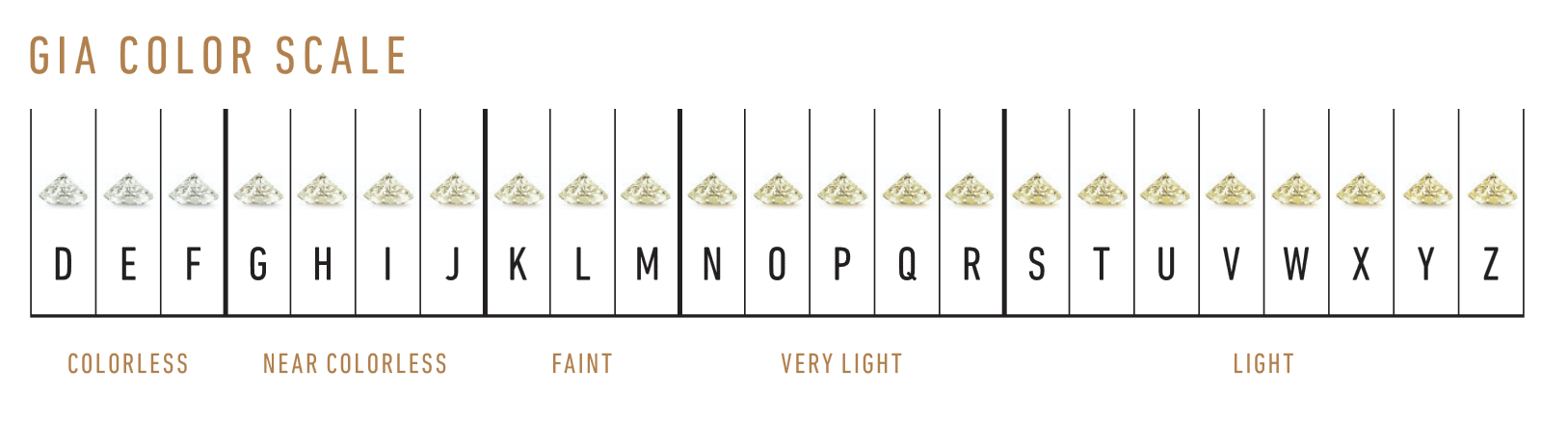
The sheer irony of a De Beers executive lamenting a lack of "uniqueness" is almost too rich to grade. The entire natural diamond monopoly was built upon aggressively standardizing the supposedly singular "round white solitaire." They relentlessly subject these so-called unique miracles of nature to the rigid D-to-Z grading scale—a wildly unimaginative spectrum dedicated exclusively to measuring a stone by exactly how many imperceptible shades of white or slightly off-white it possesses. If a gemstone's ultimate defining character and individuality boils down to whether it’s graded an "E" (colorless) or a "J" (very slightly yellow-tinted white), then true uniqueness was never the product De Beers was selling to begin with. Caught squarely between the exorbitant, fabricated markups on mined stones and the plunging retail floors of their laboratory equivalents, the diamond market's century-old house of cards is finally teetering on the brink of total collapse.
ConclusionThe Future of Forever
Our journey from 18th-century leaded "Strass" glass to the high-tech plasma reactors of 2026 represents the ultimate democratization of a manufactured dream. We have moved from fragile imitations to stones chemically and physically identical to Earth's own forging. Yet, this technological triumph forces an uncomfortable question: Why did we try so hard?
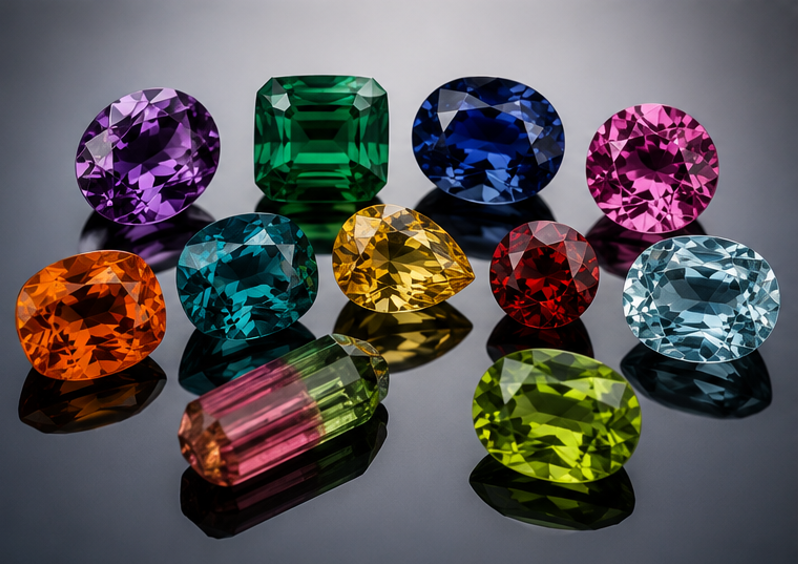
Our planet already overflows with vividly colored gemstones—rubies, emeralds, sapphires, tourmalines, spinels, tanzanites, garnets, zircons, and even a well-cut quartz—that can easily surpass a diamond in both beauty and genuine geological rarity. Instead of celebrating this natural diversity, humanity poured immense scientific capital spanning centuries, into meticulously replicating one specific, colorless stone. This is sheer human hubris, an arrogant desire to out-engineer Mother Earth.
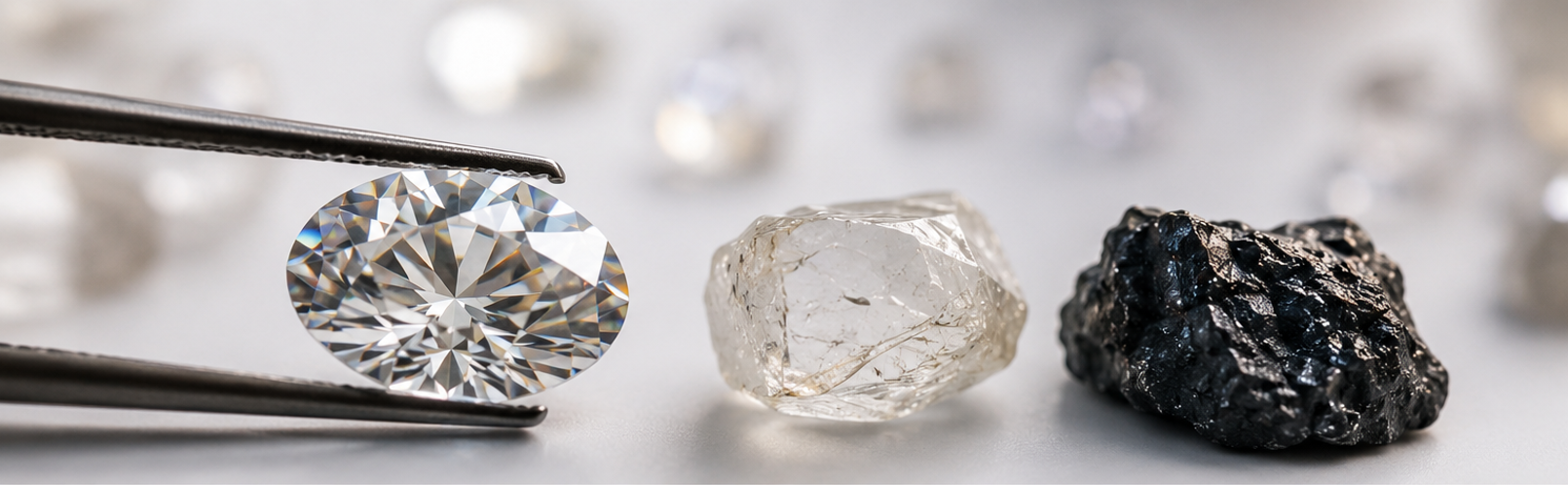
Or perhaps the truth is more cynical. The relentless quest for the perfect simulant wasn't driven by a pursuit of beauty, but by a desperate compulsion to keep pace with the greatest marketing grift in modern history. The artificial inflation of the diamond market conditioned society to equate severe financial sacrifice with romantic devotion. If love is defined by an exorbitant price tag, then the simulant industry was born to deceive; an exercise in projecting fabricated social status rather than genuine affection.
The jewelry industry famously brainwashed the world into believing "A Diamond is Forever," monopolizing the concept of eternity. Yet, natural zircon—the original diamond simulant—has existed in the Earth's crust for 4.4 billion years. It is measurably older than any diamond, older than the continents, and certainly older than a 20th-century advertising slogan.
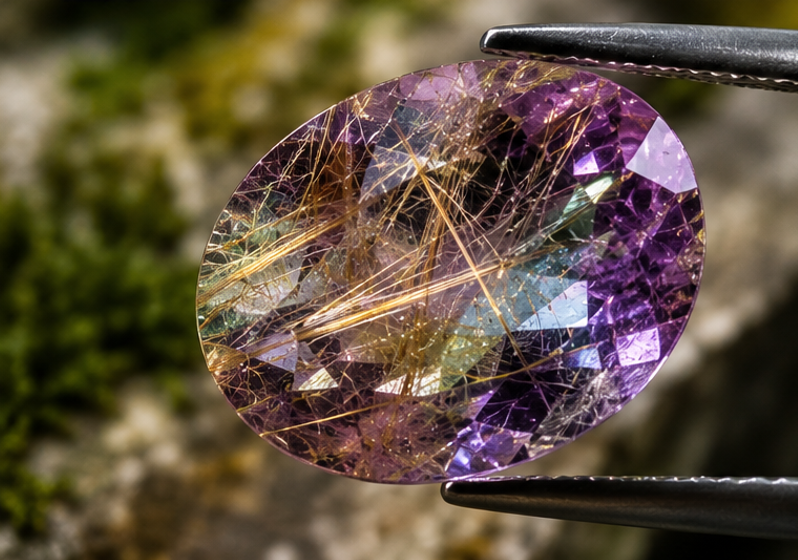
As the illusion of diamond rarity dissolves under the weight of laboratory perfection, we are finally free from the marketing dictates of the past century. The future of romantic commitment no longer needs to be chained to a small, slightly off-white, wildly overpriced solitaire. If lab-grown perfection is desired, competition will continually drive prices down. But if uniqueness and earthly beauty are valued, a colored gemstone, many of which are too complex to be replicated in a laboratory, can perfectly symbolize the brilliance of a unique connection in a way a colorless diamond simply cannot.
Let us turn our eyes instead to the Earth's authentic masterpieces. The true zenith of geological wonder lies not in sterile, carbon-copy clarity, but in the kaleidoscopic pantheon of colored gemstones including: the electric violet-blues of tanzanite, the lush greens of emerald and tsavorite, the golden-yellows of beryl, citrine, and chrysoberyl, the rainbow of colors and intense pleochroism of tourmaline, the art found meticulously cut and heavily included rutilated quartz, chalcedony, and even salt and pepper diamonds, and the fiery depths of topaz, amethyst, and spinel. Within these stones, perfection is not found in lifeless vacancy, but in the mesmerizing beauty of inclusions; the microscopic gardens, the shimmering rutile silks, and the trapped primordial fluids that serve as an indelible fingerprint of a stone's often chaotic, multimillion year gestation in the Earth. Among these titans stands a majestic, and currently wildly underappreciated gemstone; the entirely untreated majesty of the simple garnet. It is a stone of such profound, raw earthly beauty, it requires absolutely no artificial heat treatments or irradiation to coax out its breathtaking brilliance. They are found in every color, and can even exhibit the color change effect prized in alexandrite, the beautiful iridescence of spectrolite, stunning asterism and chatoyancy, and even a fire that rivals a diamond. To choose these vibrant marvels is to reject the assembly line marketing of the jewelry industry's lifeless carbon copies and wear a unique fragment of our planet manufactured over millions of years, embracing an eternal masterpiece that speaks directly to your soul, the uniqueness of your relationships, and the power and beauty our Mother Earth.